
High School Seniors Couldn’t Fill In Four Words. Their Teacher’s Emotional Video Is Raising Questions About Student Literacy.
In a now-viral video, a high school teacher records himself during his lunch break after something happened in his classroom that brought him to tears. You can watch the video below.
He teaches seniors.
Seventeen and eighteen-year-olds preparing to graduate and potentially go to college.
The assignment?
Read two paragraphs.
Complete one sentence.
That was it.
According to the teacher, he didn't simply hand his students the assignment and tell them to figure it out.
He worked through it with them.
And understanding exactly how much support he says he provided makes his reaction much easier to understand.
First, He Gave Them Sentence Stems
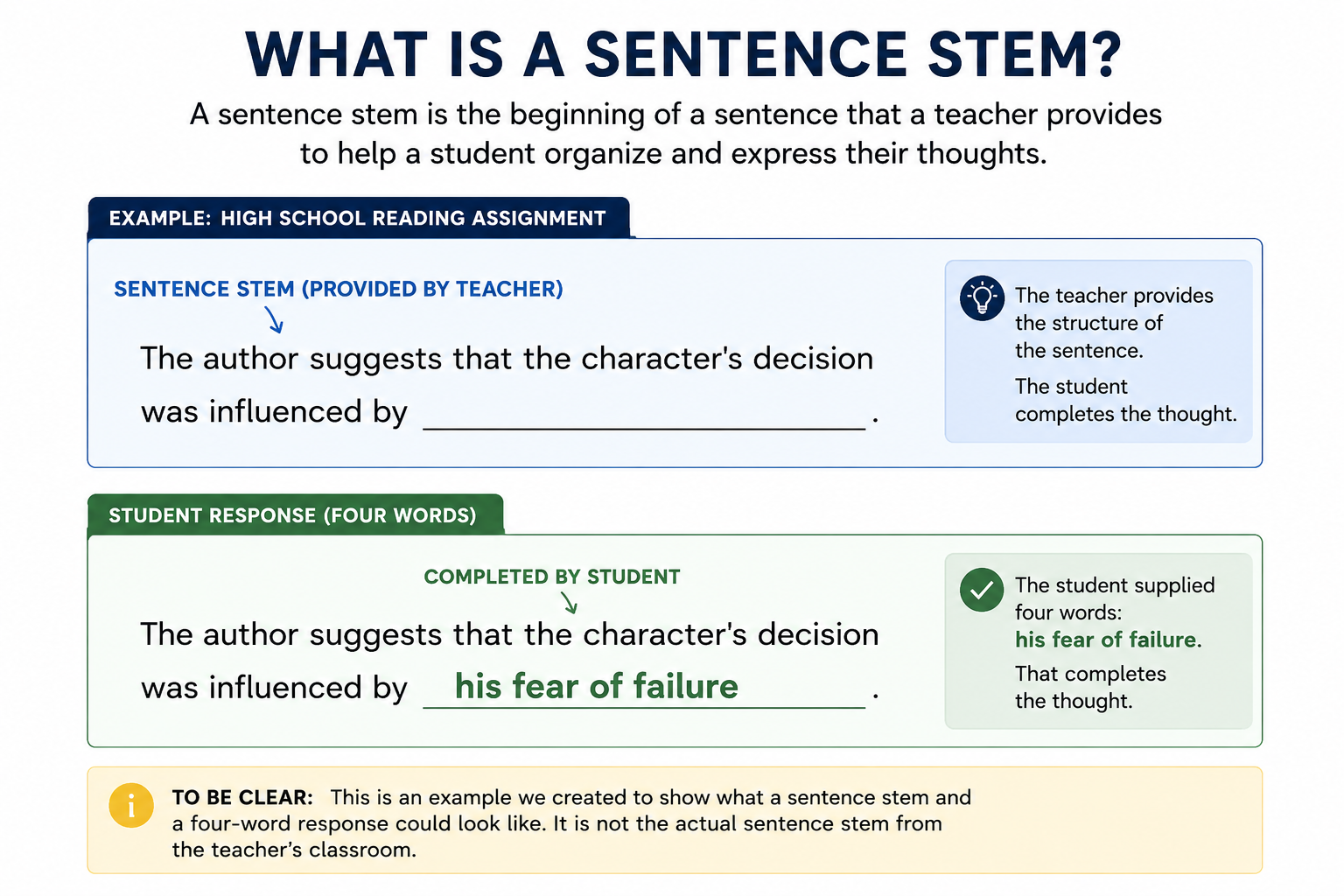
The teacher said he gave his students sentence stems.
If you're not familiar with that term, a sentence stem is the beginning of a sentence that a teacher provides to help a student organize and express their thoughts.
Instead of asking a student to create an entire written response from scratch, the teacher provides part of the sentence.
For example, a sentence stem for a high school reading assignment might look something like this:
“The author suggests that the character's decision was influenced by ________.”
After reading the text, a student might complete it:
“The author suggests that the character's decision was influenced by his fear of failure.”
The student only supplied four words:
His. Fear. Of. Failure.
The structure of the sentence was already there.
The student still has to understand what they read and identify the idea that completes the thought, but they don't have to figure out how to start or structure the entire response.
To be clear, that's an example I created to show what a sentence stem and a four-word response could look like. It is not the actual sentence stem from this teacher's classroom.
But the teacher said he provided even more support than that.
They Annotated the Reading Together
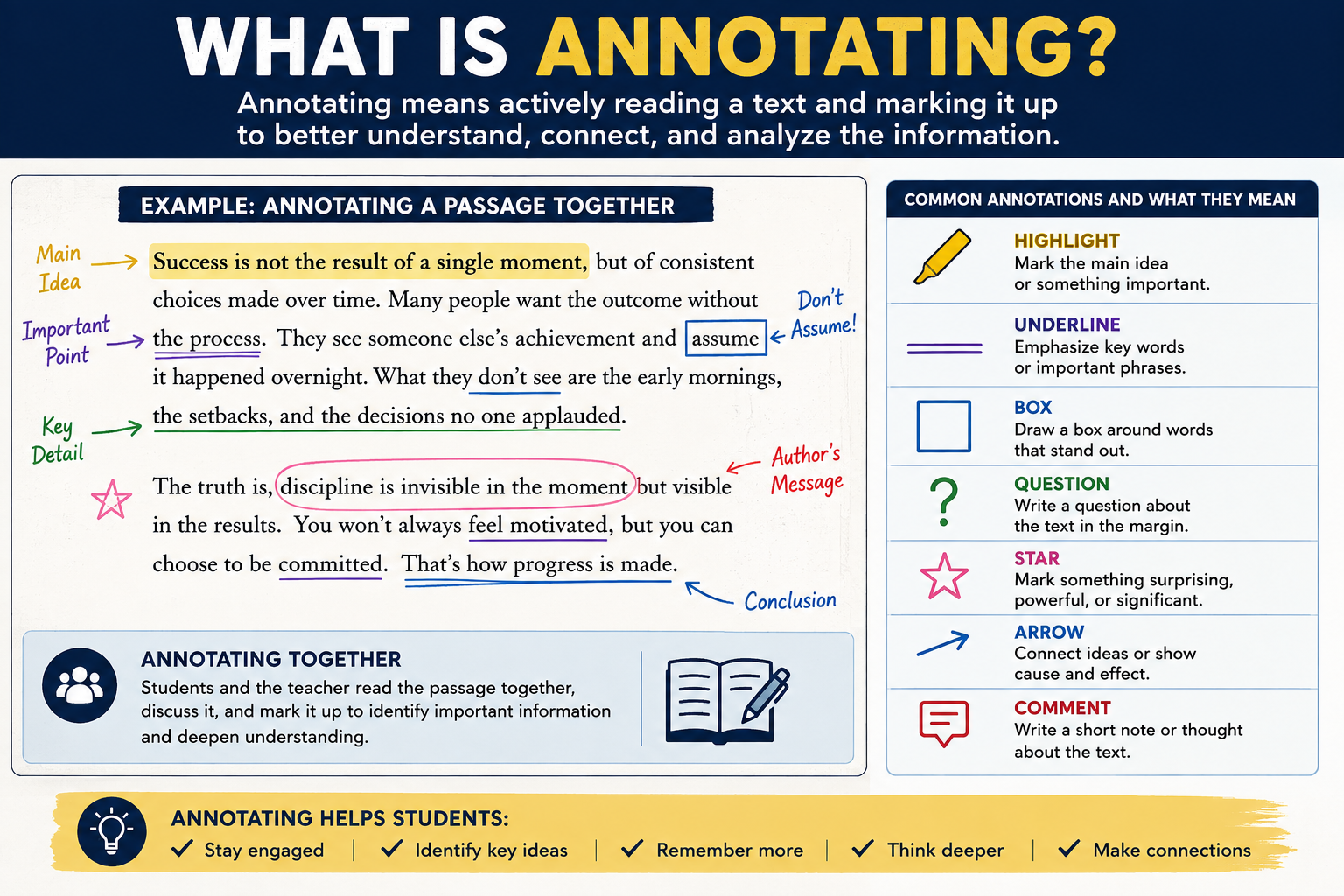
He said the class annotated the two paragraphs together.
If you're unfamiliar with that term too, annotating means actively working through a piece of writing by marking and making notes about it as you read.
Students might:
Underline an important sentence.
Circle a key word.
Identify the main idea.
Write a question beside a section.
Make a note about what a sentence means.
Connect one idea to another.
In other words, the teacher didn't just hand them two paragraphs and say:
Figure it out.
According to him, they worked through the reading together.
They discussed it.
They marked it up.
He gave them the sentence stems.
He walked them through the scenario.
He said he had basically given them the answers before they even got to the problem.
Then the students needed to fill in four words.
Four words.
And they couldn't do it.
The teacher became visibly emotional.
“These are 17 and 18-year-old kids, and they couldn't fill in four words. Four words!”
Then he said something even harder to hear:
“I have seniors who simply cannot read and seniors who cannot write. They cannot write.”
But what he said next may be the most important part of the entire video.
He said these students could reason.
They could defend their reasoning when talking with their friends.
So the ability to think wasn't necessarily missing.
The problem came when they had to take what they were thinking, connect it to something they had read and communicate those thoughts through writing.
That should concern all of us.
What Happens When Nobody Gives Them the Sentence Stem?

Think about what a sentence stem really represents.
It's support.
Someone gives you the beginning.
You have to finish the thought.
That's useful in a classroom.
But eventually, the stems disappear.
College doesn't always give you the beginning.
Your employer won't always give you the beginning.
A customer won't.
A contract won't.
A financial decision won't.
A problem you've never faced before won't.
Life won't.
At some point, young people have to be able to take information, understand it, form their own thoughts, communicate those thoughts and decide what to do next.
That's why what happened in this classroom is about much more than four missing words.
What happens when nobody gives them the sentence stem?
Graduation Can't Be the Finish Line

We spend a lot of time asking whether students are prepared to graduate.
Maybe we should spend more time asking whether they're prepared for what happens after graduation.
A diploma is an accomplishment.
But young people also need to know how to take information and do something with it.
Can they understand it?
Question it?
Form their own opinion?
Explain what they think?
Use what they've learned to make a decision?
Those aren't just school skills.
They're life skills.
College skills.
Career skills.
Leadership skills.
And entrepreneurship skills.
Realistic CEO™ Isn't Just About Starting Businesses
When people hear "CEO," they often think about business.
Starting a company.
Making money.
Being your own boss.
But that's not the entire point of Realistic CEO™.
Not every Realistic CEO™ student needs to become an entrepreneur.
But every student will eventually have to make decisions about their own life.
That's where CEO begins.
Before you can lead employees, you have to learn to lead yourself.
Before you can make business decisions, you have to learn how to make decisions.
Before you can communicate a vision, you have to learn how to communicate a thought.
Before you can solve a customer's problem, you have to learn how to think through a problem.
And before you can challenge how something has always been done, you have to become curious enough to ask:
Why?
What Does a Realistic CEO™ Student Look Like?

When we started thinking about the kind of student we want Realistic CEO™ to help develop, we didn't start with business plans.
We didn't start with revenue.
We didn't start with pitch competitions.
We started with curiosity.
A Realistic CEO™ student is curious about the world around them.
They want to learn.
They read and think independently.
They go beyond the assignment.
They don't simply accept an answer because someone gave it to them.
They ask questions.
Why does this work?
Why didn't that work?
Why do we do it this way?
What happens if I try something different?
What am I missing?
What do I think?
And eventually:
What am I going to do with what I know?
Knowing the answer is important.
Knowing how to think when you don't have the answer may be even more important.
READ. THINK. EXPLAIN. DO.
The teacher's video made me think about a simple framework that belongs at the center of what we're building with Realistic CEO™.
READ.
Take in the information.
Don't immediately wait for someone else to explain it.
Don't immediately ask technology to summarize it.
Read it.
Try to understand it.
THINK.
What did you just read?
What does it mean?
Do you agree?
Do you disagree?
Why?
What questions do you have?
What conclusions can you draw?
EXPLAIN.
Now put your thoughts into your own words.
Say it.
Write it.
Defend it.
If someone asks why you believe something, can you explain your reasoning?
DO.
Now use what you've learned.
Make a decision.
Solve something.
Build something.
Test something.
Create something.
Take action.
READ. THINK. EXPLAIN. DO.
Then do it again.
And again.
The goal is to eventually be able to do all four without someone standing beside you telling you what comes next.
Entrepreneurship Can Be the Laboratory

This is why I believe entrepreneurship education can be about much more than teaching children how to start businesses.
Entrepreneurship gives students a place to practice thinking.
Give a student an idea and start asking questions.
Who needs this?
Why would they buy it?
How do you know?
What evidence do you have?
What happens if nobody buys?
Why didn't your first idea work?
What would you change?
How would you explain your idea to someone who disagrees?
What did you learn?
What are you going to do next?
There isn't always one correct answer.
That's the point.
Students have to think.
They have to make decisions.
They have to communicate.
They have to try.
Sometimes they have to fail.
Then they have to decide what to do next.
They're learning how to operate when nobody gives them the sentence stem.
Then There's AI

Today's students also have access to something previous generations didn't.
Artificial intelligence can write the sentence for them.
It can summarize the paragraphs.
Write the essay.
Answer the questions.
Create the presentation.
Develop the business idea.
That's powerful.
But there's a big difference between using AI to help you think and using AI so you don't have to think.
We shouldn't prepare young people for an AI-powered world by teaching them to compete with AI.
And we shouldn't let AI do all of their thinking for them.
We need young people who can use AI as a tool.
That means they still need to know how to ask questions.
Challenge an answer.
Recognize when something doesn't make sense.
Make a judgment.
Add their own ideas.
And decide what to do next.
AI can give young people answers.
We still have to teach them what to do with those answers.
The Ability May Already Be There
This is the part of the teacher's video I keep coming back to.
He said his students could reason.
They could defend their reasoning when talking with their friends.
That matters.
Because it suggests there may be ideas, intelligence, opinions and experiences inside these students that aren't making it onto the page.
Reading and writing still matter.
Maybe more than ever.
We need to help students build a bridge between:
What I think.
What I understand.
What I can explain.
What I can do.
Having a great idea in your head isn't enough if you can't communicate it.
Knowing something isn't enough if you can't use it.
Potential matters.
But eventually, potential has to become capability.
Life Is Coming
Near the end of the video, the teacher becomes even more emotional while talking about the young Black and Brown boys and girls he teaches.
You can hear his concern about what happens to them next.
And that's what makes this bigger than one English assignment.
These young people are getting older whether they're prepared or not.
Graduation is coming.
College is coming for some.
Work is coming.
Bills are coming.
Contracts are coming.
Decisions are coming.
Mistakes are coming.
Opportunities are coming.
Life is coming.
We can't prepare young people for every problem they'll face.
But we can give them opportunities to practice thinking for themselves before the stakes get higher.
Maybe We Need to Rethink What “Prepared” Means
Being prepared doesn't simply mean knowing information.
Information has never been easier to find.
Being prepared means knowing what to do with information.
Can you understand it?
Can you question it?
Can you explain it?
Can you use it?
Can you make a decision when there isn't an obvious answer?
Can you recover when you're wrong?
Can you figure something out?
That's the kind of preparation I want Realistic CEO™ to contribute to.
We're not trying to replace teachers.
We're not trying to replace schools.
And entrepreneurship isn't the answer to every challenge in education.
We're creating another place where young people can practice becoming curious, independent thinkers and put that thinking to work.
Because the goal can't simply be getting students across the graduation stage.
We have to prepare them for what happens when nobody gives them the sentence stem.
Belief Is Only the Beginning
Realistic CEO™ started with a simple idea:
Young people shouldn't be told their ambitions are unrealistic simply because adults can't see how they're going to accomplish them.
But belief is only the beginning.
There has to be something between believing you can do something and actually doing it.
Curiosity.
Comprehension.
Critical thinking.
Communication.
Problem-solving.
Decision-making.
Execution.
Action.
Those are the muscles we want young people to exercise.
Not because every child needs to become the CEO of a company.
Because every young person will eventually be responsible for something much more important:
Their decisions.
Their opportunities.
Their future.
The teacher's video shouldn't just make us emotional.
It should make us ask what we're going to do about it.
So, What Are We Going to Do About It?
Concern isn't enough.
Sharing the video isn't enough.
Arguing about who is responsible isn't enough.
At some point, we have to create more opportunities for young people to practice the skills we're worried they're losing.
Opportunities to read.
To think.
To ask why.
To explain themselves.
To solve problems.
To make decisions.
To try something.
To get it wrong.
To learn.
And to try again.
That's part of what we're building with Realistic CEO™.
The book is part of it.
The enrichment experience is part of it.
School engagement is part of it.
The podcast is part of it.
But the bigger mission is helping young people move from believing something is possible to developing the thinking, skills and experiences needed to pursue it.
Because we don't just want students prepared to complete the next assignment.
We want them prepared for the day when nobody gives them one.
READ. THINK. EXPLAIN. DO.
If you want to understand how we're putting that philosophy into practice, the next step isn't another article about the problem.
It's seeing what we're building as part of the solution.
Explore the Realistic CEO™ Blueprint and see what we're building for the next generation.
See the Realistic CEO™ Blueprint →